example 1
链接见:https://pubs.acs.org/doi/10.1021/jacs.5b00256
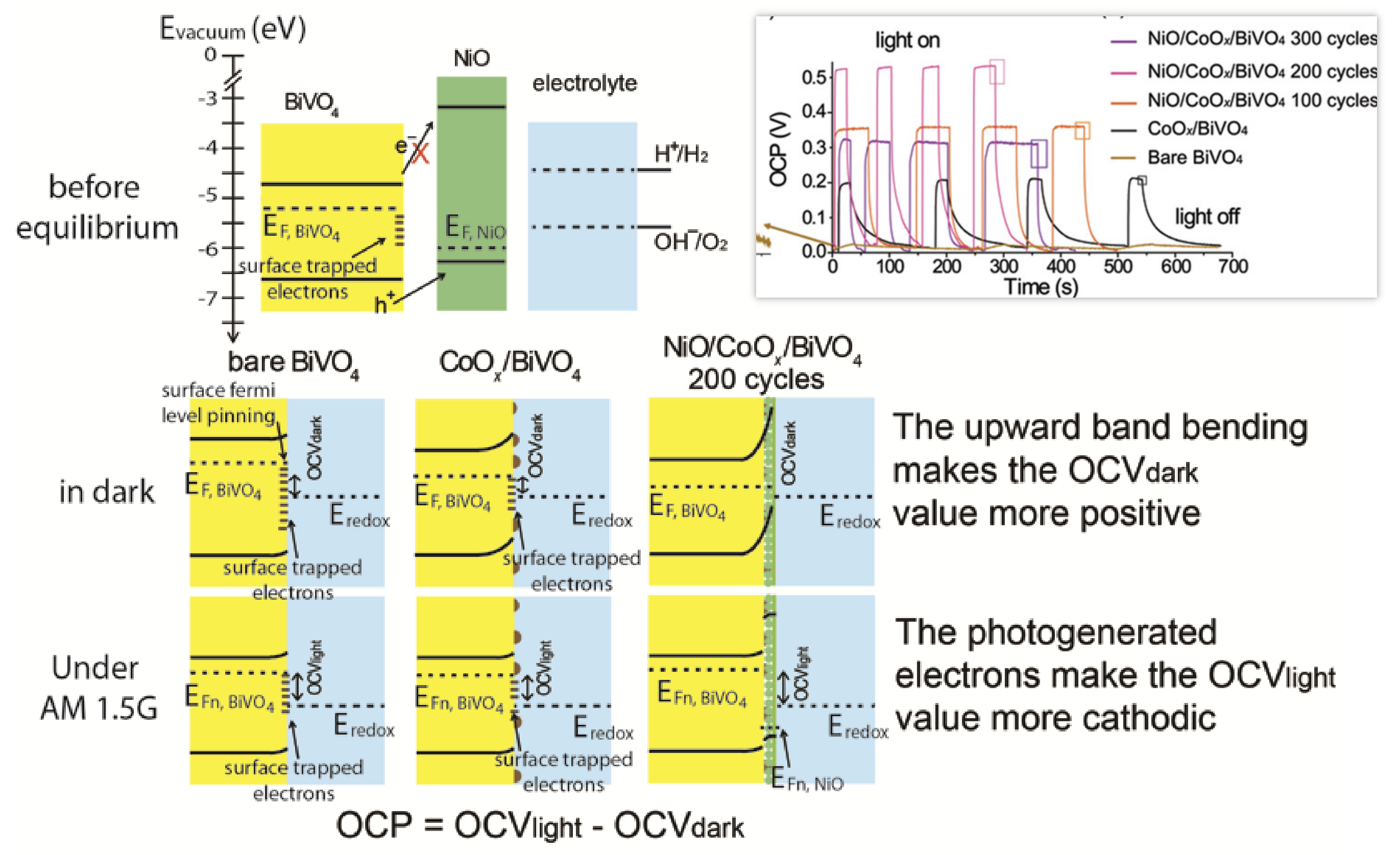
description: To further discuss the enhanced PEC performances with the CoOx and NiO modifications, the open circuit photovoltage (OCP) of the photoanodes in the same solution of 0.1 M KPi at pH 7 in dark and under AM 1.5G illumination were measured. OCP = open circuit voltage upon AM 1.5G illumination (OCVlight) – open circuit voltage in dark (OCVdark, also known as resting potential) represents the amount of the band bending at the time being with respect to that in the dark condition, for each of the constructed electrode structures. OCV is the most positive in dark due to the largest energy band upward bending, and OCV is more cathodic under illumination, with the energy band rather flattened by photoexcited carriers. (39-41) The degree of the band bending is determined by the built-in potential in the photoanode/electrolyte junction, the minority carrier accumulation and the charge recombination. An enlarged band bending at the photoanode/electrolyte interface represents the enhanced electron–hole separation. We demonstrate that the conformal deposition of _p_-type NiO on the CoOx/BiVO4 surface effectively enlarges the band bending. The OCP is systematically increased from the bare BiVO4 to the CoOx/BiVO4 and to the 200-ALD-cycle NiO/CoOx/BiVO4 photoanode (Figure 5c). OCP decreases in the 300-ALD-cycle NiO/CoOx/BiVO4 photoanode, presumably because of the increased electron–hole recombination in the thick NiOOH film. The OCPs is repeatable under intermittent irradiation (Figure 5c) and consistent with the corresponding PEC performances. Note that kinetic or catalytic effect should be ruled out in the open circuit condition as current arising from the assumed redox reactions does not pass steadily. These observations indicate that the formation of an enlarged band bending at the photoanode/electrolyte junction is decisive for the high PEC performance. (8)
The schematic illustrations of the band bending corresponding to the measured absolute OCVdark and OCVlight values of the bare BiVO4, the CoOx/BiVO4, and the NiO/CoOx/BiVO4 photoanodes are shown in Figure S14. The more cathodic OCVlight values indicate the flattened energy band of the photoanodes (in light quasi-equilibrium with the electrolyte) by the photoexcited carriers. OCVlight is mostly determined by the negatively Fermi level shifts in the photoanode materials under illumination. In contrast, the OCVdark reflects the upward band bending nature of the photoanodes in dark equilibrium with the electrolyte. More positive OCVdark values were obtained with the NiO/CoOx/BiVO4 samples suggesting the effective passivation of the BiVO4 surface states for the reduced surface Fermi leveling pinning effect. As a result, the enlarged band bending was formed after the conformal ALD NiO deposition. It is necessary to mention that our OCV measurements were performed under Ar bubbling conditions, which is the same condition in the PEC photocurrent measurements. In addition, the Ar bubbling rules out the possibility of the surface states passivation by the surface O2 absorption in the O2 saturated electrolyte. Therefore, we can conclude that the improved OCPs were realized at the photoanode/electrolyte junction by the conformal ALD NiO surface modifications.
example 2
链接见:https://pubs.acs.org/doi/full/10.1021/acsenergylett.9b00153
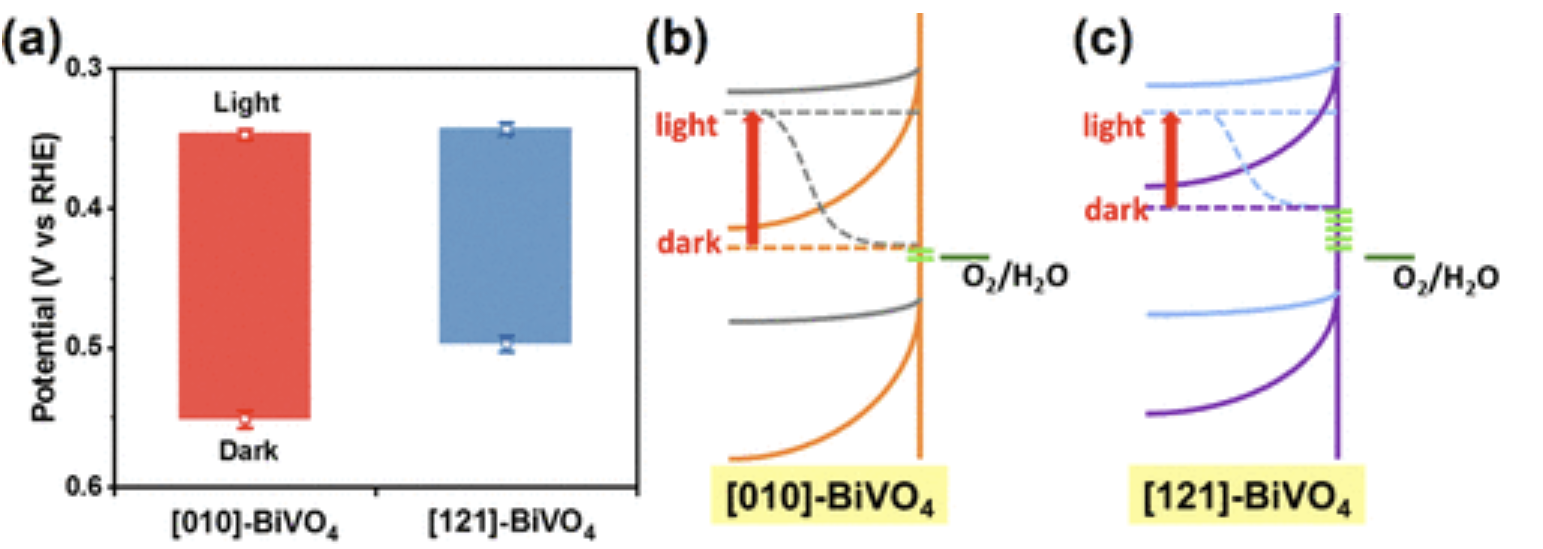
description: To begin, we first evaluated the intensity of surface band bending of the semiconductors. Considering the different configuration of the crystal arrays, the exposing facet ratios of two samples differ from each other; that is, more {011} facets are exposed for [010]-BiVO4, while more {010} facets are exposed for [121]-BiVO4. As reported, the {011} facets of decahedral BiVO4 crystal show a more intense band bending than {010} facets. (35) Thus, [010]-BiVO4 with a relatively larger ratio of {011} facets is expected to show a higher intensity of overall band bending than [121]-BiVO4, which can be evidenced by the open-circuit potentials (OCPs) under dark and irradiation conditions. (36) Note that the irradiation intensity was adjusted to be high enough to produce a flat band condition of the photoanodes. As shown in Figure 3a, the OCPs of [010]-BiVO4 (0.343 ± 0.004 VRHE) and [121]-BiVO4 (0.347 ± 0.003 VRHE) under irradiation are similar, indicating similar flat band potentials of the two photoanodes. This is consistent with the result of the MS plots (Table S1). Under dark conditions, the OCP of [010]-BiVO4 (0.551 ± 0.006 VRHE) is larger than that of [121]-BiVO4 (0.497 ± 0.005 VRHE). The larger difference of OCPs under dark and irradiation conditions of [010]-BiVO4 corresponds to a more intense band bending of [010]-BiVO4, which can be attributed to the different Fermi level pinning effect caused by the surface states on different facets. (36,37) The surface states were further evidenced by the derivative from the Mott–Schottky plots (Figure S7b). (38,39) The emerged peaks in Figure S7b indicate the existence of the intraband surface states. Specially, the broader peak for [121]-BiVO4 as compared to [010]-BiVO4 suggests a higher density of surface states and thus a greater extent of Fermi level pinning over [121]-BiVO4. The band-bending conditions of [010]-BiVO4 and [121]-BiVO4 based on the OCPs are schematically illustrated in Figure 3b,c. It is clear that [010]-BiVO4 demonstrates a more intense band bending than [121]-BiVO4, contributing to an improved ηsep.
转载请注明来源,欢迎对文章中的引用来源进行考证,欢迎指出任何有错误或不够清晰的表达。